One Colour Standard, Three Substrates: How to Match Dye Shades Across Leather, Textile and Paper
A brand signs off a single colour — say a deep olive — then applies it to a leather bag, a woven lining and a printed carton. Three suppliers, three dye systems, three processes. On the meeting-room table the samples look identical. Under the shop lights the lining reads greener; in daylight the carton reads greyer. Nobody is incompetent; the substrates are doing what substrates do. This guide explains why one standard drifts across materials, which variables you can control from the purchase order, and how to write a shade spec that three factories can actually hit.
Key Takeaways
- A colour standard is not a number — it is a physical sample plus a measurement condition. Without both, "match this" means three things.
- Shade drift across substrates comes from three sources: substrate chemistry, application method, and surface optics. Fix the optics first, because they cause the arguments.
- Metamerism is a purchasing problem, not a dye problem. Naming your illuminants is cheaper than re-dyeing a lot.
- Set a separate tolerance per substrate. Paper and leather cannot be held to the same Delta E window, and pretending otherwise guarantees a rejected shipment.
- Demand dips on your own material. A dip on the wrong substrate proves nothing.
What Is Cross-Substrate Colour Matching?
Cross-substrate colour matching is holding one approved colour across materials dyed by different chemistries, on different equipment, at different stages of manufacture. It is routine wherever a product combines hide, fabric and paper in one bill of materials.
The mistake most buyers make is treating it as a dye problem. It is three problems stacked:
- Chemistry. Leather is a collagen protein with an amphoteric surface and a pH that moves during processing. Cellulosics are negatively charged and need electrolyte and heat before anionic dye will strike. Paper is cellulose plus fillers and retention aids, and the dye must survive a wet-end that looks nothing like a dye bath.
- Application. A tannery drum runs a long float at controlled pH with a fixation step. A textile mill may pad and dry in seconds. A paper machine colours at the wet end or size press, where retention and two-sidedness decide the shade.
- Optics. Glossy corrected-grain leather reflects light differently from a matte woven lining, and coated board differently again. Identical dye concentration on two surfaces can measure several Delta E apart purely from texture.
Buyers who understand the stack stop asking one factory to "match the other factory's sample" and start specifying what the standard is, where it is judged, and how much drift each material is allowed.
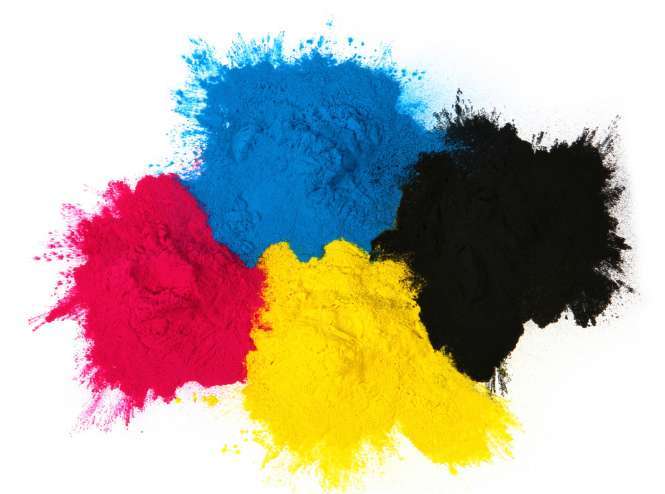
One standard, several dye classes. The powder colour tells you almost nothing about the result on a given substrate.
Technical Specifications: What a Shade Standard Must Contain
A workable colour standard has six components. Most purchase orders carry one or two, which is where the disputes begin.
| Element | What to state | Why it matters in practice |
|---|---|---|
| Physical standard | Sealed, dated reference sample per substrate, signed by both parties, stored away from light | A digital file cannot be matched. A faded chip cannot be disputed. |
| Measurement geometry | Spectrophotometer with specified aperture, specular component included or excluded, UV included or excluded | Included vs excluded specular alone can move a glossy leather reading noticeably. |
| Illuminants | Primary and secondary, typically daylight and a store or office illuminant, with the observer angle | Two samples can be a perfect match under one light and visibly different under another. |
| Tolerance | Delta E method (CIE76, CMC or CIEDE2000), numeric limit, and the pass/fail rule per substrate | Mixing Delta E formulae between supplier and buyer makes the number meaningless. |
| Visual check | Grey-scale rating for change in colour, assessed by a trained pair of eyes under a viewing cabinet | Instruments miss what customers see. Visual assessment is still the final arbiter. |
| Sample size and stage | The exact substrate, thickness and finish the dip is made on, and whether it is measured before or after topcoat | A dip measured on crust leather tells you nothing about the finished, finished-grain article. |
Two practical notes. State the Delta E formula explicitly: a CIEDE2000 value of 1.0 and a CIE76 value of 1.0 are not the same distance. Then decide whether the tolerance applies to the dip, the bulk, or both, and where measurement happens — ambiguity there is the most common reason a conforming shipment is rejected.
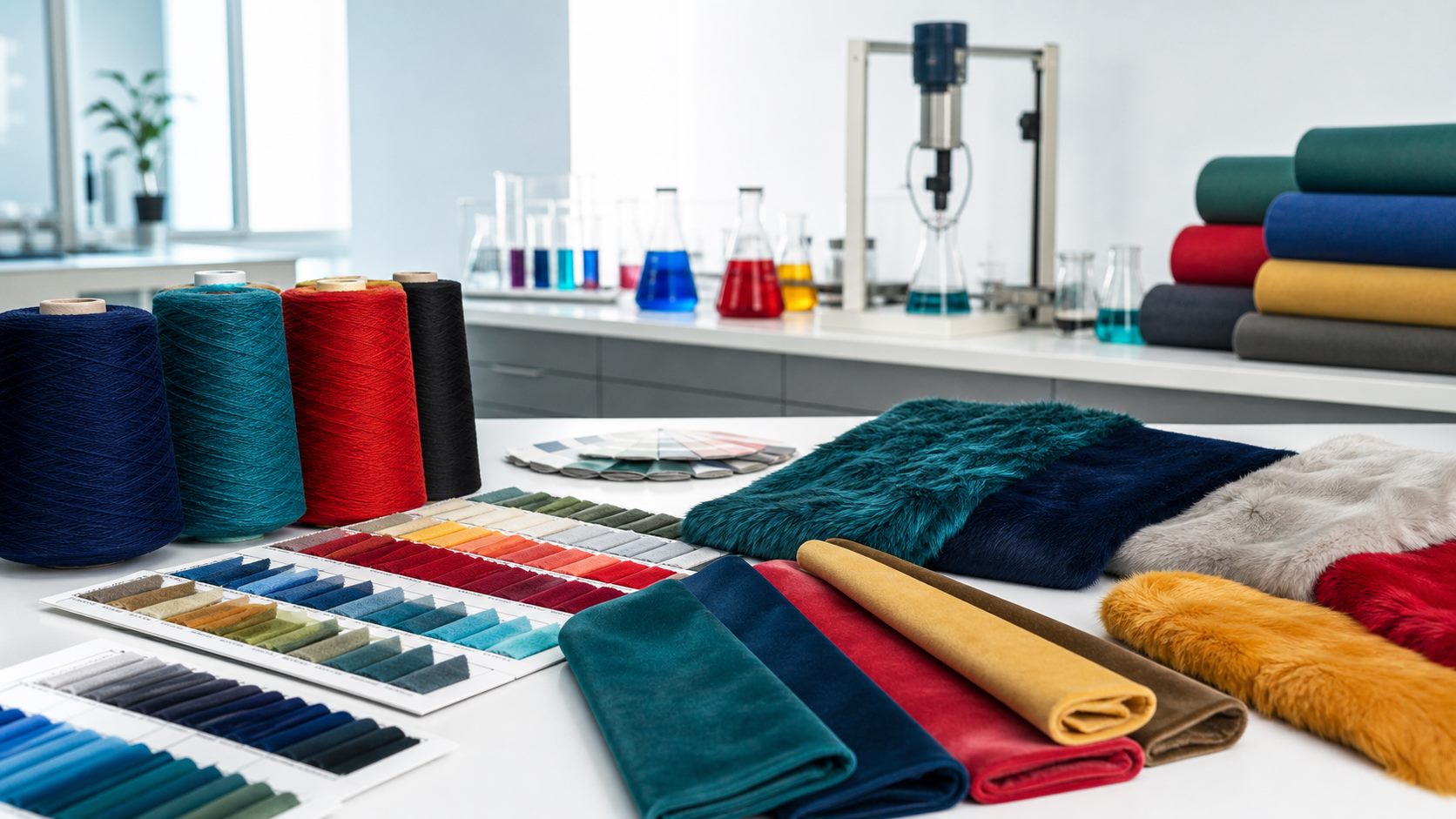
Textile substrate in production. Padding, exhaust and continuous routes each shift shade differently.
Comparison of Options: How Each Substrate Behaves
The table compares the three groups on the variables that actually move shade. Treat the dye classes as starting points, not fixed assignments — the right class depends on fibre blend, finish and fastness target.
| Factor | Leather | Textile | Paper |
|---|---|---|---|
| Typical dye classes | Acid, direct, and metal-complex dyes; pigment dispersions for coating | Acid for nylon and wool; direct for cellulosics; reactive or vat where wet fastness is critical | Direct and basic dyes; pigment dispersions for coating and tinting |
| Application route | Drum dyeing in float, or spray and pad for crust and finishing | Exhaust, pad-dry, pad-steam, or continuous ranges | Wet-end addition to stock, or size-press / coating application |
| Main shade drivers | Crust pH, fatliquor loading, penetration depth, topcoat opacity | Fibre blend, electrolyte, temperature curve, fixation and wash-off | Furnish brightness, filler type, sizing, retention aid, machine speed |
| Surface effect on reading | Strong — grain pattern and gloss shift perceived depth | Moderate — yarn texture and pile scatter light | Moderate to strong — coating and calendering change gloss |
| Fastness priority | Light, rub, flex and water spotting | Wash, rub, light, perspiration | Light and bleed resistance in the finished print or board |
| Where shade is usually lost | Between crust and finished article, after topcoat | At wash-off and drying, and in heat setting | Between lab hand-sheet and full machine run |
| Tolerance reality | Tighter on aniline, looser on heavily pigmented finishes | Tighter on flat wovens, looser on pile and heathers | Tighter on white and pastel, looser on deep shades |
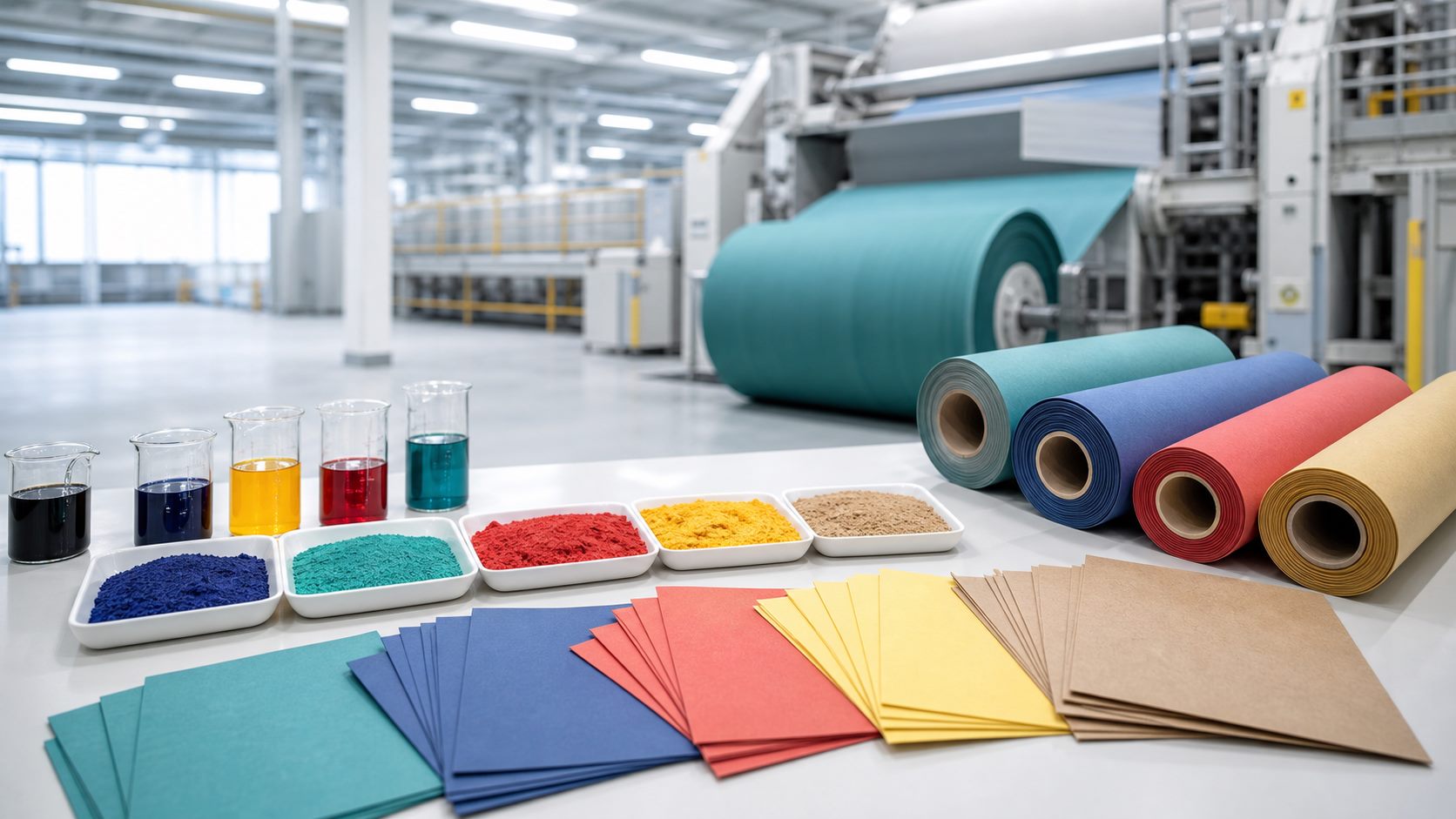
Paper is the substrate that punishes assumptions hardest: furnish and filler move the shade before the dye does.
How to Choose the Right Option: Five Steps
- Fix the master standard first. Pick one substrate as the reference — usually the one with the most area or highest perceived value — approve that physical sample, measure it, record the conditions and seal two sets. Everything else is matched to that reference, never to another factory's production.
- Rank the substrates by how far they can move. Paper and aniline leather drift most; flat wovens least. Set the tightest tolerance on the reference and widen it deliberately where the material cannot hold it.
- Ask for a dip on your material. Not their standard cloth, not a generic crust, not a lab hand-sheet when the job runs on a machine. Send the actual substrate, name the finish stage, and measure the dip the way you will measure bulk.
- Test the pair under both illuminants. Set the standard beside the dip in a viewing cabinet, under daylight and under the store light you named. If they diverge, re-balance the dye combination — often replacing part of one colourant with a pair that flattens the curve — rather than adding strength.
- Write the approved dip into the purchase order. Attach shade code, substrate, measurement conditions, tolerance and retention period, then state what happens on failure: who pays for re-work, the re-dip timeline, whether a second submission is allowed.
Quality-Control Evidence: What Proves a Match
Suppliers will tell you the shade is right. The question is what they can put in an email. Ask for evidence in this order:
- Spectral data, not just a Delta E number. Reflectance curves for standard and submission show whether a pass is genuine or two errors cancelling out. A single number hides the direction of the miss.
- A signed, dated dip card per substrate. The physical dip remains the record of truth; the printout supports it, it does not replace it.
- Batch-numbered COA for the bulk lot. Strength, shade direction and moisture, tied to the drums that actually shipped, so a later complaint can be traced.
- Fastness results on the relevant substrate. A lightfastness figure measured on wool says little about the same dye on chrome-tanned leather or coated board.
- Retention samples held by both parties. Kept in the dark, labelled with batch, date and shade code. Without them, a dispute six months later is an opinion contest.
Packaging & Shipping: Keeping a Multi-Substrate Programme Clean
A cross-substrate programme usually means several dye classes in one shipment — acid for the leather, direct for the lining, paper dye for the board. That adds handling risks a single-product order does not have.
- One readable label per unit. Product name, shade code, batch number, strength, net weight, production date and the substrate it was approved for. Unlabelled inner bags are how a lining dye ends up in a tannery drum.
- Segregate by product family on the pallet. Acid, direct, basic and pigment products should not share an unmarked layer. Where they must share a pallet, mark the layers and put the segregation on the packing list.
- Keep the moisture barrier intact. Powder dyes are hygroscopic: fibre drums with an inner liner or multiply sacks with a sealed inner bag, plus a container desiccant plan for sea freight. Caked powder weighs the same and disperses badly.
- Match unit size to consumption. A 25 kg drum suits a tannery running daily; a small printer may want 5 or 10 kg units used before they pick up moisture. State it on the order, not at packing time.
Common Buyer Mistakes
Buyer Checklist
Before you issue the purchase order
FAQ
Can one dye be used on leather, textile and paper to guarantee a match?
Rarely, and not reliably. A direct dye may appear on all three substrates, but the application chemistry, the substrate's affinity and the fastness requirement differ enough that the same product will not deliver the same result. You match the colour, not the dye — using the class that performs on each substrate, then balancing the recipe to the shared standard.
Why do two samples match in the office and clash in the showroom?
That is metamerism: two colourant combinations with different spectral curves that coincide under one light source. It is common when one substrate is dyed with a three-colour combination and another with a different trio. Test under both illuminants before approval, and where it persists, re-balance the combination rather than adjust strength.
What Delta E should I specify?
There is no universal answer. Set it from what your customer will accept on that material under your inspection light, then confirm the supplier can hold it in bulk, not only in a lab dip. Name the formula — CIEDE2000, CMC or CIE76 — because the same number means different distances in each.
Is a lab dip enough to approve a bulk order?
Necessary but not sufficient. A dip proves the supplier can reach the shade at small scale. It does not prove batch-to-batch consistency or that the machine run behaves like the lab. Approve the dip, hold the first bulk lot to it, and keep a retention sample from each batch.
How do we handle paper that shifts shade with recycled furnish?
Accept that furnish variation is a raw-material variable you cannot dye your way out of. Fix the furnish specification as tightly as the mill allows, set a wider tolerance on recycled-content board than on virgin, and ask for a shade-adjustment recommendation rather than a fresh reformulation each time the furnish moves.
Can you supply all three dye families in one shipment?
Yes. GLIDE™ covers acid, direct, paper and textile dye ranges from the same plant: one document set, one batch-numbering convention, one contact. Unit sizes and labelling can be set per line so each site receives material it can identify without opening the packaging.
Conclusion
Cross-substrate colour matching fails for boring reasons: an unsealed standard, an unnamed illuminant, a tolerance borrowed from the wrong material, a dip made on the wrong cloth. None of these need new chemistry. They need a purchase order that says what the standard is, where it is judged, and how far each substrate may drift.
Get those into writing and the conversation with your supplier changes from "this doesn't match" to "here is the reading, here is the curve, here is the delta" — which ends in a correction rather than a claim.
Send Us Your Standard
Tell us the substrate, the finish stage and the illuminants you inspect under. We will dye a dip on your material and send the spectral data with it.
Factory: +86 138 6922 6336 | WhatsApp: +44 7895 584241
Email: info@dyespro.com
GLIDE™ dyes — manufactured by Dezhou Jinmao Chemical Co., Ltd.
Manufacturer of GLIDE™ leather, textile and paper dyes
Factory: +86 138 6922 6336 · WhatsApp: +44 7895 584241
Email: info@dyespro.com · Web: www.dyespro.com