ZDHC Level 3 Dyes for Leather: What Buyers Must Verify Before the Container Ships
You place a bulk dye order, the drums arrive, production runs fine — and then a brand audit asks for the chemical conformance file. If your supplier's "ZDHC compliant" claim was verbal, or the certificate doesn't carry your specific product code, you're now the one holding the problem. The hides may already be cut. The shipment may already be scheduled. And the cost of proving compliance after the fact is far higher than demanding it before payment.
ZDHC Level 3 is the tier most footwear, automotive, and fashion brands name when they require conformant chemistry. But "Level 3" gets used loosely in supplier emails, and the details matter enormously at the audit stage. This guide breaks down what Level 3 actually certifies, how it differs from the other two tiers, what documented evidence you should collect, and where buyers most often go wrong when sourcing ZDHC-conformant dyes from China.
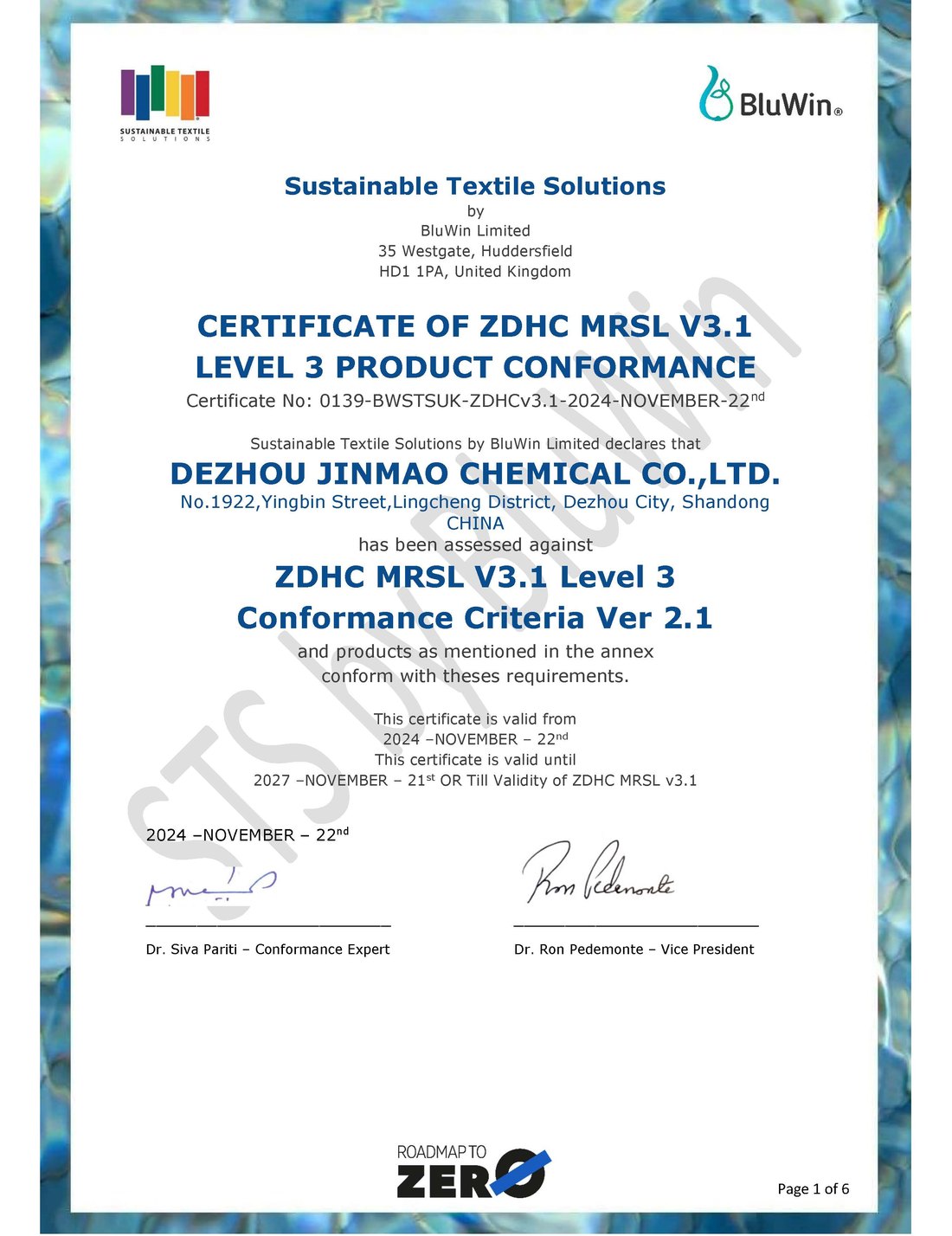
GLIDE™ dye ZDHC conformance documentation — always request the current certificate for your exact product code.
Key Takeaways
- Level 3 is the highest MRSL conformance tier. It requires full formulation disclosure to an independent assessor, not just a test of the finished dye.
- MRSL governs inputs, RSL governs outputs. A ZDHC dye claim is about the chemistry you buy; it is not the same as testing your finished leather.
- A certificate covers specific product codes. A supplier-wide "we are ZDHC conformant" statement proves nothing about the drum in front of you.
- Verification lives on the ZDHC Gateway and InCheck. Level 3 listings carry a certificate number you can trace — treat untraceable claims as unproven.
- Conformance is date-stamped. Certificates expire and MRSL versions change, so re-verify with every new order, not once at onboarding.
What Is ZDHC Level 3?
The ZDHC Foundation (Zero Discharge of Hazardous Chemicals) is a multi-stakeholder programme backed by major brands, chemical manufacturers, and tanneries. Its central tool for chemical buyers is the Manufacturing Restricted Substances List (MRSL), currently published as version 3.1. The MRSL sets maximum concentration limits for substances that must not be intentionally used in the chemicals a factory applies during manufacturing — including restricted azo amines, chlorinated phenols, APEO/NPEO surfactants, phthalates, formaldehyde, heavy metals such as lead, cadmium, mercury and chromium(VI), organotin compounds, and chlorinated solvents.
ZDHC defines three increasing levels of MRSL conformance for chemical formulations such as dyes:
- Level 1 — Meets MRSL: The finished chemical has been analytically tested and falls within MRSL limits. Results are typically self-declared by the supplier.
- Level 2 — Certified: An accredited, independent third party has tested the product and confirmed MRSL compliance, issued as a recognised certification.
- Level 3 — Certified + Conformant: The supplier has disclosed the full formulation to an independent reviewer, who confirms that no restricted substances are present above limits — verifying compliance at the ingredient level, not only in the finished blend.
That last distinction is the one that matters to a tannery. A dye can pass a finished-product test while still containing a restricted precursor or an impurity that only surfaces in your process — during fixation, in your effluent, or in the finished hide after ageing. Level 3's formulation-level review closes that blind spot, which is why it is the tier brands most often name when they require "ZDHC compliant" chemistry in the leather supply chain.
Technical Specifications
The table below summarises the main MRSL v3.1 substance categories, why each is relevant to a tannery running dye, and the kind of method a conformance assessment would reference. Specific limits are set by the published MRSL — always read them from the current ZDHC document rather than a supplier's summary.
| Substance Category (MRSL v3.1) | Why It Matters to a Tannery | Typical Check |
|---|---|---|
| Restricted azo amines | Can cleave from certain dye structures and appear on finished leather | Analytical screen of the finished dye |
| APEO / NPEO surfactants | Common in levelling agents; environmentally persistent | Formulation disclosure + finished-goods test |
| Chlorinated phenols (PCP, TeCP) | Preservation-related; restricted in major markets | Finished-goods analytical test |
| Formaldehyde | Can carry through from dye synthesis or finishing | Finished-goods test against limits |
| Heavy metals (Pb, Cd, Hg, Cr VI) | Impurities from raw materials and process water | Trace-metal analysis |
| Phthalates & organotins | May appear in auxiliary or carrier components | Formulation review + finished-goods screen |
GLIDE™ leather, acid, and direct dye formulations are produced under ZDHC MRSL conformance, with quality and environmental management systems structured around ISO 9001:2015 and ISO 14001:2015. The certificate that matters is the one carrying your exact product code — not a general company statement.
Comparison of Options
Buyers frequently treat the three conformance levels as interchangeable "compliant" labels. They are not. The table below shows what each actually proves and where it leaves you exposed.
| Conformance Level | What Is Assessed | Who Verifies | Buyer Exposure |
|---|---|---|---|
| Level 1 — Meets MRSL | Finished dye tested against MRSL limits | Supplier self-declaration | Highest — claim rests on the supplier's own word |
| Level 2 — Certified | Finished dye independently tested | Accredited third party | Moderate — test covers the product, not its inputs |
| Level 3 — Certified + Conformant | Full formulation reviewed against MRSL | Independent assessor | Lowest — ingredient-level assurance |
For leather destined for European or North American brands, Level 3 is normally the safe default. Where a brand's own chemical list is less stringent, Level 2 documentation may be accepted — but confirm that in writing with your customer before you commit to a supplier tier.
How to Choose the Right Option
Work backwards from the brand requirement to the dye order. Five steps keep the compliance chain intact.
- Confirm what your customer actually requires. Ask the brand or buyer to state the ZDHC level and MRSL version in writing. "ZDHC compliant" is not a specification; "MRSL v3.1, Level 3" is.
- Match the dye class to your process first. Acid, direct, and metal-complex dyes behave differently on chrome, vegetable-tanned, suede, and nubuck leathers. Conformance does not replace dye performance — you still need the right class for the substrate.
- Ask for the certificate against your product code. Request the ZDHC conformance certificate naming the specific formulation you intend to buy, with its certificate number and expiry date. A catalogue-wide claim is not acceptable evidence.
- Trace the claim on the ZDHC Gateway. Level 3 listings can be checked against the supplier's published entry. If the certificate number cannot be traced, treat the claim as unverified.
- Lock the requirement into the purchase order. State the ZDHC level, MRSL version, and required documents in the PO, so the obligation sits with the supplier rather than on your QC team after arrival.
Quality-Control Evidence
Compliance is only as good as the paperwork behind it. A supplier operating to a genuine management system can provide, on request and without excuses:
- ZDHC conformance certificate naming your exact product code, with certificate number and validity period.
- Batch-numbered Certificate of Analysis for the shipment, covering the parameters you specified (strength, shade, moisture, insolubles, and any fastness data relevant to your application).
- Current MRSL version reference so you can confirm the certificate was issued against the version your brand requires.
- Retention samples kept by the supplier from your production batch, so a dispute months later can be resolved against the actual material shipped.
- Safety Data Sheet (SDS) in the format your destination market requires, aligned with the GHS version in force there.
Do not accept a screenshot of a certificate with the product code blurred out, and do not accept a certificate for a "similar" product. The point of Level 3 is traceability to the exact formulation in the drum.
Packaging & Shipping
Compliance documents must travel with the goods, not sit in a filing cabinet in China. When you specify a shipment of ZDHC Level 3 dye, make sure:
- The product code on the drum label matches the code on the certificate — a mismatch is the fastest way to fail an incoming audit.
- Each drum's batch number links to the COA supplied with the shipment.
- ZDHC and SDS documentation is included in the shipping document set, not sent separately by email after arrival.
- Export packaging uses moisture-resistant liners and food-grade-compatible inner bags where relevant, so dye powder is not degraded by sea-freight humidity in transit.
- Pallets are ISPM 15 heat-treated and marked, avoiding fumigation delays at destination.
Common Buyer Mistakes
Buyer Checklist
Before You Release Payment for ZDHC-Level-3 Dye
FAQ
Is ZDHC Level 3 the same as "ZDHC approved"?
No. "Approved" has no defined meaning under the ZDHC programme. Conformance runs through Levels 1 to 3, and Level 3 (Certified + Conformant) is the highest. Always ask for the level and the certificate number.
Does a ZDHC certificate mean my finished leather is compliant?
Not by itself. A ZDHC dye certificate shows your input chemistry is MRSL-conformant. Your finished leather still has to be tested against the brand's RSL — a separate requirement covering the article you sell.
How do I verify a supplier's ZDHC claim?
Ask for the conformance certificate naming your product code, then check the certificate number against the supplier's entry on the ZDHC Gateway. If the number cannot be traced, the claim is unproven.
Do all GLIDE™ dyes carry ZDHC conformance?
GLIDE™ dye formulations for leather, acid, and direct applications are produced under ZDHC MRSL conformance. Because certificates attach to specific product codes and validity dates, request the current certificate for the exact product you intend to order.
What is the difference between MRSL v3.1 and earlier versions?
The MRSL is periodically revised, and each version changes limits or adds substance categories. Your brand will specify the version it accepts — always match the certificate to that version rather than assuming the latest is automatically interchangeable.
Can I get ZDHC documentation for a trial order, not just bulk?
Yes — and you should. Request the certificate and COA with your sample or trial order so you can validate both the compliance file and the dye's performance on your own substrate before committing to a container.
Conclusion
ZDHC Level 3 is not a slogan you take on trust — it is a documented, traceable claim that attaches to a specific dye formulation on a specific date. For leather manufacturers, the discipline is straightforward: confirm the level and MRSL version your brand requires, match the dye class to your substrate, demand a certificate carrying your product code, trace it on the Gateway, and write the requirement into the purchase order. Do that, and the compliance file is ready before the container ever leaves China.
Need ZDHC-Conformant Dye for Your Next Order?
Dezhou Jinmao Chemical Co., Ltd. manufactures GLIDE™ leather, acid, and direct dyes under ZDHC MRSL conformance. Send us your product code and destination market, and we will provide the current conformance certificate and a batch-numbered COA with your quotation.
Factory: +86 138 6922 6336 | WhatsApp: +44 7895 584241
Email: info@dyespro.com
Dezhou Jinmao Chemical Co., Ltd.
Manufacturer of GLIDE™ dyes — leather, acid, direct, textile, paper, fur, wood, and aluminium applications.
Factory: +86 138 6922 6336 | WhatsApp: +44 7895 584241 | Email: info@dyespro.com
Web: www.dyespro.com