ZDHC Level 3 Dyes: What Leather Manufacturers Need to Know
A tannery's chemical compliance now sits directly in its sales pipeline. European and North American footwear, automotive, and fashion brands increasingly require proof — not promises — that the dyes and auxiliaries in your drum are free of the substances on the ZDHC MRSL. If your dye supplier can't produce a valid conformance certificate, your finished leather can be rejected at the brand's incoming inspection, or your own customer audit can fail before a single hide ships.
"ZDHC Level 3" is the phrase buyers hear most often, but few understand what it actually certifies — and what it doesn't. This guide explains the three conformance levels, what Level 3 requires of a dye manufacturer, and how to verify the claim before you wire payment for a container of dye.
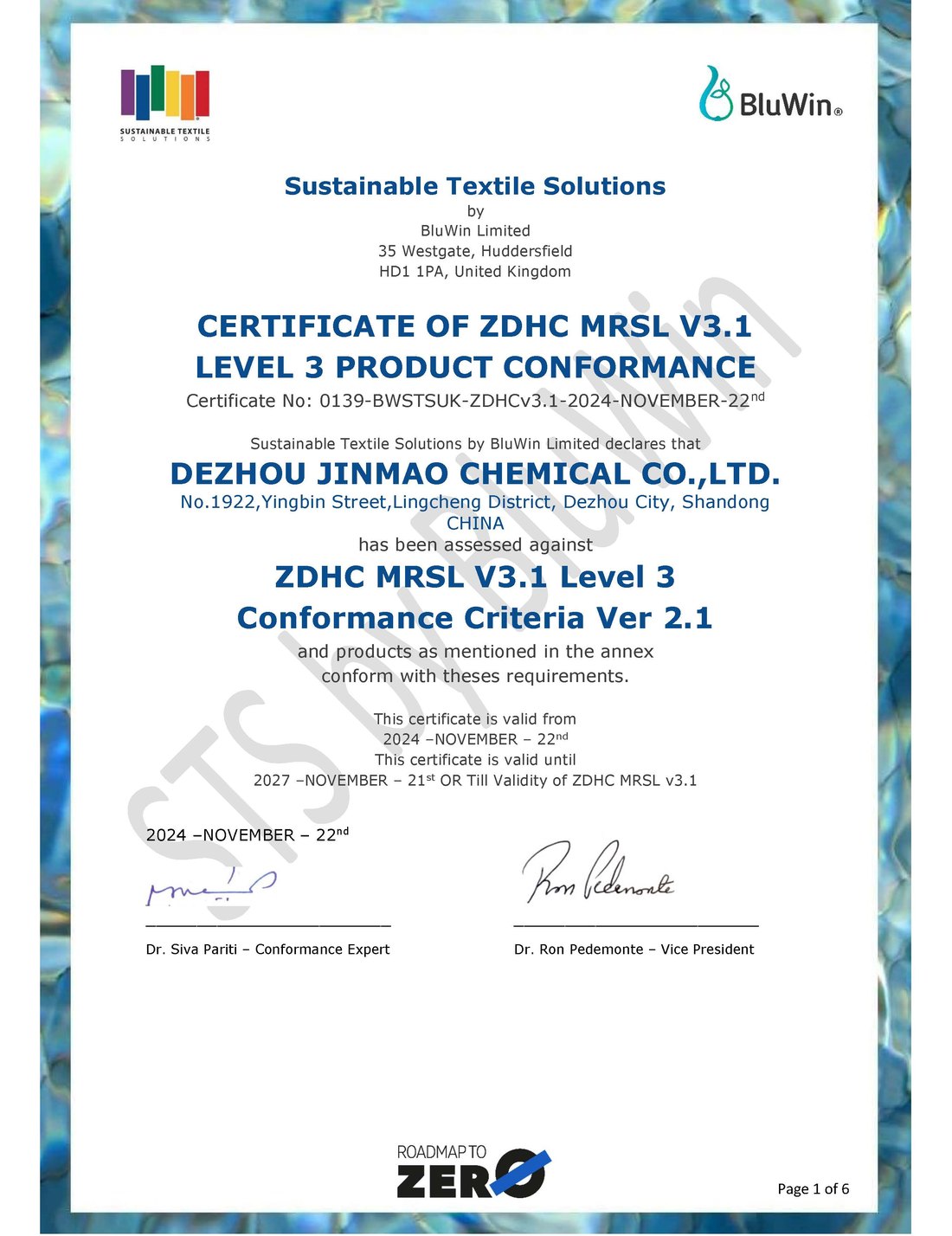
GLIDE™ dye ZDHC conformance documentation — request the current certificate for your specific product code.
Key Takeaways
- ZDHC Level 3 is the highest conformance tier — it requires full formulation disclosure to an independent reviewer, not just a lab test of the finished dye.
- MRSL ≠ RSL. The Manufacturing Restricted Substances List governs the chemicals you buy and put in your drum; the Restricted Substances List governs the finished leather you ship.
- Level 1 and Level 2 are not equivalent to Level 3. Know the difference before a supplier's "ZDHC compliant" claim costs you a rejected batch.
- Always verify the certificate against the product code — a conformance certificate covers specific formulations, not a supplier's entire catalog.
- Conformance is audited and re-confirmed over time. Request the current certificate and scope details with every new order, not just the first one.
What Is ZDHC Level 3?
The ZDHC Foundation (Zero Discharge of Hazardous Chemicals) is a multi-stakeholder initiative backed by major brands, chemical suppliers, and tanneries. Its core tool for chemical buyers is the Manufacturing Restricted Substances List (MRSL), currently published as version 3.1. The MRSL sets maximum concentration limits for substances that must not be used in chemicals applied during manufacturing — including restricted azo amines, chlorinated phenols, APEO/NPEO surfactants, phthalates, formaldehyde, heavy metals such as lead, cadmium, mercury and chromium(VI), organotin compounds, and chlorinated solvents.
ZDHC defines three increasing levels of MRSL conformance for chemical formulations:
- Level 1 — Meets MRSL: The finished product has been analytically tested and results fall within MRSL limits. Results are typically self-declared by the supplier.
- Level 2 — Certified: An accredited, independent third party has tested the product and confirmed MRSL compliance, issued as a recognized certification.
- Level 3 — Certified + Conformant: The supplier has disclosed the full formulation to an independent reviewer, who confirms no restricted substances are present above limits — verifying compliance at the ingredient level, not only in the finished blend.
For a leather manufacturer, Level 3 removes the main blind spot of lower tiers: a dye can pass a finished-product test while still containing a restricted precursor or impurity that surfaces in your process or in the hide. Level 3's formulation-level review closes that gap. It is the tier brands most often name when they require "ZDHC compliant" chemistry in their supply chain.
Technical Specifications
The table below summarizes the substance categories a ZDHC Level 3 dye must satisfy, and why each matters to a tannery. GLIDE™ leather, acid, and direct dye formulations are produced under ZDHC MRSL conformance, with quality and environmental management systems audited to ISO 9001:2015 and ISO 14001:2015.
| Substance Category (MRSL v3.1) | Why Brands Restrict It | Relevance to Leather Dyes |
|---|---|---|
| Restricted azo amines (24 listed amines) | Some azo colorants can cleave into carcinogenic aromatic amines | Direct check on the dye's chromophore and impurities |
| Chlorinated phenols (PCP, TeCP) | Persistent, toxic, bioaccumulative; former biocide/preservative use | Legacy preservatives and cross-contamination |
| APEO / NPEO surfactants | Endocrine disruption; degradation products persist in water | Common wetting/dispersing agents in dye formulations |
| Heavy metals (Pb, Cd, Hg, Cr(VI)) | Acute and chronic toxicity | Impurities in raw dyestuff and metal-complex dyes |
| Formaldehyde | Carcinogenic; skin and respiratory sensitizer | Fixatives, dispersants, and some dye after-treatments |
| Organotin compounds | Toxic to aquatic life; endocrine disruption | Historically used as stabilizers/biocides |
| Chlorinated solvents & phthalates | Occupational and environmental hazard | Carriers and plasticizers in some formulations |
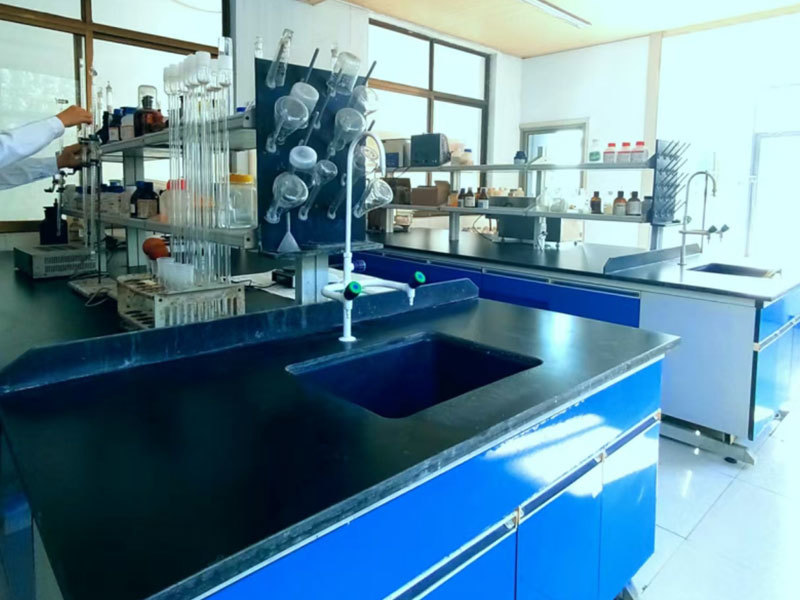
In-house quality control verifies every GLIDE™ production batch before release; ZDHC conformance is independently reviewed.
Comparison of ZDHC Conformance Levels
| Attribute | Level 1 | Level 2 | Level 3 |
|---|---|---|---|
| What is verified | Finished product meets MRSL limits | Product tested & certified by an independent third party | Full formulation disclosed & reviewed; ingredient-level conformance |
| Who performs the review | Supplier (self-declared) | Accredited certifier | Accredited certifier with formulation disclosure |
| Detects hidden precursors/impurities | No | Partially | Yes |
| Typical acceptance by EU/US brands | Rarely sufficient alone | Often accepted for non-leather parts | Standard requirement for leather input chemicals |
| Cost to buyer (typical) | Lowest | Moderate | Highest assurance, comparable unit pricing |
How to Verify a Supplier's ZDHC Level 3 Claim
- Ask for the certificate first, not the price. A genuine Level 3 conformance is supported by a certificate that names the certifier and the product family. If the supplier can only say "yes, we're compliant" without a document, treat it as unverified.
- Match the certificate to your exact product code. Conformance is issued per formulation. Ask the supplier to confirm in writing that the certificate covers the specific dye code on your PO — a Level 3 certificate for one acid dye does not automatically cover a different direct dye.
- Check scope, version, and validity. Confirm the certificate references the ZDHC MRSL version you need (v3.1) and note the issue date. MRSL limits are updated periodically, so a certificate from years ago may not reflect current thresholds.
- Request the supporting lab and management-system documents. A credible dye supplier pairs ZDHC conformance with ISO 9001 (quality) and ISO 14001 (environmental) management. These back up the claim that conformance is maintained batch after batch, not as a one-off test.
- Demand a COA with every batch. The certificate proves the formulation is conformant; the Certificate of Analysis proves the batch you actually received matches that formulation. Both should travel with every shipment.
Quality-Control Evidence
We won't print certificate numbers or lab IDs in a blog post, because those documents are product-specific and time-bound — and any number we show today could be stale for your order tomorrow. What we can state plainly is how GLIDE™ conformance is maintained, so you know what to look for from any supplier:
- ZDHC MRSL conformance is held at the formulation level for GLIDE™ leather, acid, and direct dye ranges, with documentation displayed for buyer reference on the dyespro.com certifications page.
- ISO 9001:2015 quality management governs production, batch traceability, and COA issuance.
- ISO 14001:2015 environmental management governs effluent control and responsible manufacturing.
- Batch-level COA is issued with every shipment, recording physical properties, dye strength, and shade against the approved standard.
When you request documents, always give the exact product name and intended application. Conformance scope varies by formulation, and a responsible supplier will confirm scope in writing rather than send a generic "we're certified" PDF.
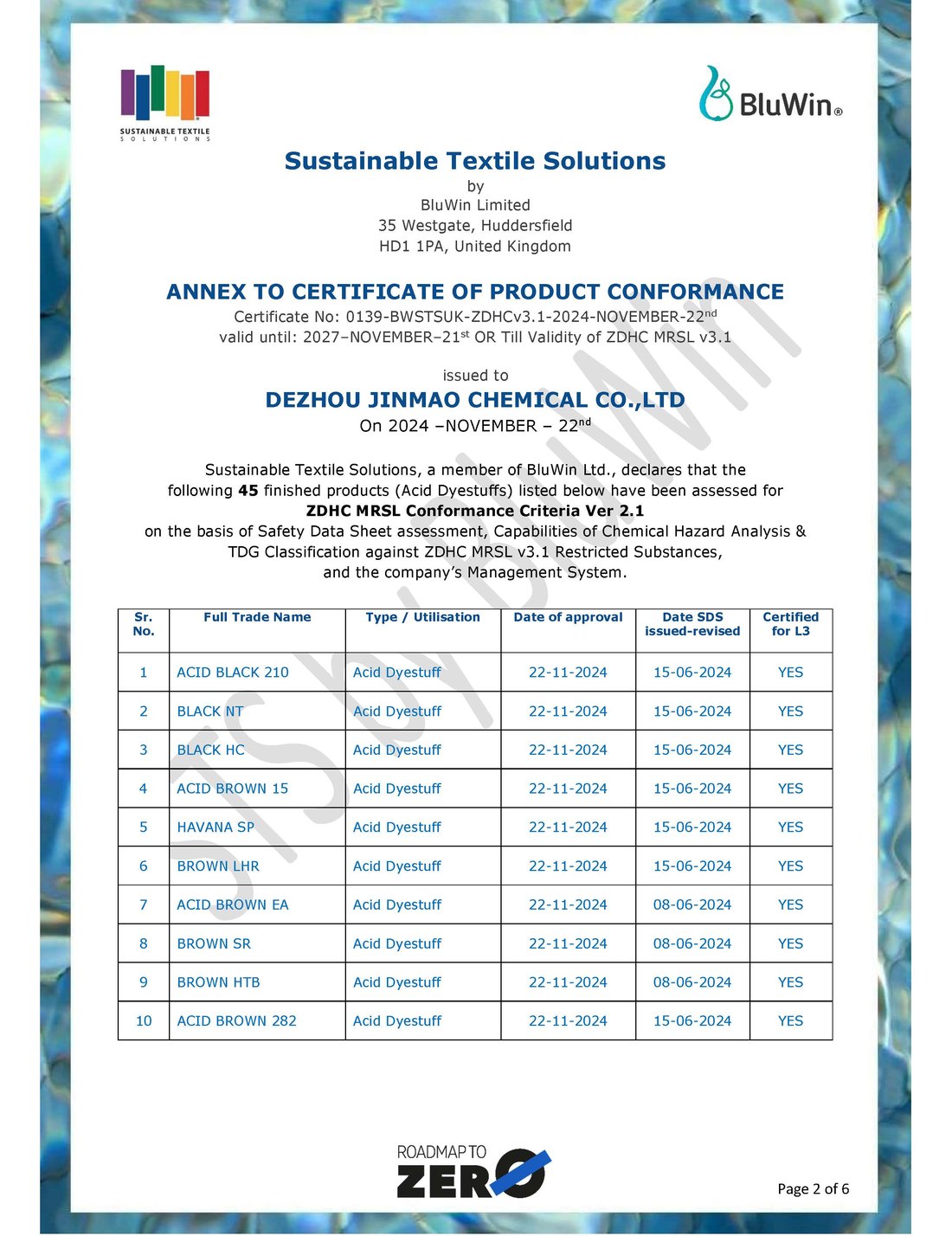
Conformance documentation is issued per product family — confirm your specific dye code is within scope.
Packaging & Shipping for Conformant Dyes
Compliance survives only if the dye reaches your drum uncontaminated. GLIDE™ dyes ship in sealed, clearly labeled packaging — standard 25 kg drums or bags, with larger FIBC options for bulk container orders. Every package carries batch number, product code, and a COA reference so the batch can be traced back to its production and test record. Ask your logistics team to specify packaging format based on your port's handling conditions, and keep drums sealed until use to preserve conformance and avoid cross-contamination in your warehouse.
Five Common Buyer Mistakes
Buyer Checklist: Before You Order ZDHC Level 3 Dyes
Frequently Asked Questions
What is the difference between ZDHC Level 1, 2, and 3?
Level 1 means the finished product tested within MRSL limits, typically self-declared. Level 2 means an independent third party tested and certified the product. Level 3 means the full formulation was disclosed to and reviewed by an independent certifier, verifying compliance at the ingredient level. Level 3 is the highest assurance and the tier most brands require for leather input chemicals.
Is ZDHC Level 3 the same as the RSL?
No. The MRSL (Manufacturing Restricted Substances List) governs input chemicals like dyes; the RSL (Restricted Substances List) governs finished articles like the leather you ship. A Level 3 dye satisfies MRSL requirements for your inputs, but you must still meet your customer's RSL on the finished leather.
How do I verify that a certificate is still valid?
Check the issue date and the MRSL version it references (currently v3.1). Confirm the product scope in writing with the supplier. If in doubt, request the current certificate for your specific product code before placing the order — conformance documents are re-issued and re-confirmed over time.
Does one ZDHC certificate cover all GLIDE™ dyes?
Conformance is issued per formulation, so scope varies by product family and code. Always send the exact product name when requesting documents, and the GLIDE™ team will confirm whether that specific code is within the certified scope.
What substances does the ZDHC MRSL restrict?
MRSL v3.1 sets limits across several categories, including restricted azo amines, chlorinated phenols (PCP, TeCP), APEO/NPEO surfactants, phthalates, formaldehyde, heavy metals (lead, cadmium, mercury, chromium VI), organotin compounds, and chlorinated solvents. A conformant dye must fall within these limits at the ingredient level.
Do ZDHC Level 3 dyes cost more?
Formulation-level conformance does add upstream cost in disclosure and auditing, but at bulk order volumes the per-kilogram impact is modest. More important: the cost of a rejected batch or a failed brand audit far outweighs the small premium of a conformant dye. Request a quote with the certificate in hand rather than comparing price alone.
Can I get a sample to test before committing to a bulk order?
Yes. GLIDE™ offers trial samples so your lab can run shade, fastness, and application trials before a container order. Ask for the COA and conformance document alongside the sample so you are validating the exact product you will eventually buy.
Verify Before You Buy — Request Your GLIDE™ Conformance Documents
ZDHC Level 3 is only worth what it documents. Before you commit to a bulk dye order, ask for the current certificate, confirm your product code is in scope, and demand a batch COA with every shipment. The team at Dezhou Jinmao Chemical supplies GLIDE™ conformant dyes to tanneries worldwide — and we'll send the documentation with the sample, not after the invoice.
Send your product code and application, and we'll confirm scope and ship a trial sample:
📧 info@dyespro.com | 📞 +86 138 6922 6336 | 💬 WhatsApp: +44 7895 584241
Dezhou Jinmao Chemical Co., Ltd. — Manufacturer of GLIDE™ dyes
Factory: Dezhou, Shandong Province, China
📞 Factory: +86 138 6922 6336 | 💬 WhatsApp: +44 7895 584241 | 📧 Email: info@dyespro.com
Website: www.dyespro.com